
Reviewed · POMPEII TOURS
Pompeii and Herculaneum Small Group Tour with an Archaeologist
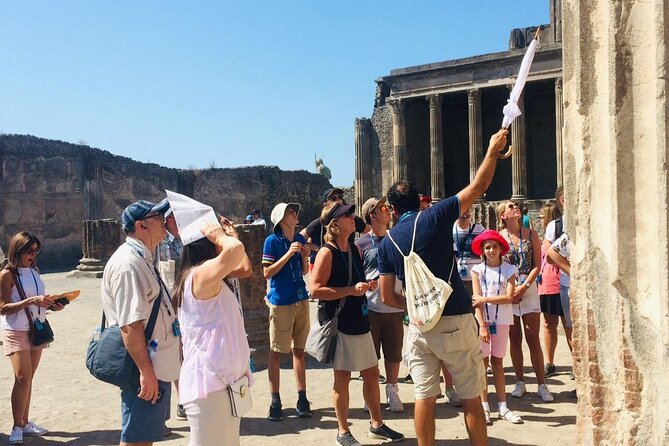
Pompeii and Herculaneum are close on a map, but they tell different stories of the eruption of Vesuvius. This small-group archaeologist tour connects the two sites in one day, with stops at Pompeii’s Forum, House of the Faun, and Stabian Baths, then Herculaneum’s houses, baths, and public buildings. I like that the guide gives the ruins a human scale, and that entry tickets and headsets are included.
I also like having the between-site transfer arranged, especially if you’re starting in Naples, Sorrento, or Rome. The trade-off is time: about two hours at each sprawling site makes this a highlights tour, not a slow, complete visit. Pompeii, in particular, can leave you wishing you had another day.
- Two ancient towns, two different impressions: Pompeii spreads across a large urban area; Herculaneum offers a more compact visit and remarkably preserved homes.
- An archaeologist leads both visits: Guides including Michele, Diego, Paulo, and Antonio have brought buildings, decoration, and daily life into focus.
- Entry tickets and headsets are included: You can skip the ticket lines and hear the guide during the walk.
- Transport depends on your starting point: Naples, Sorrento, and Rome options use a minibus for site transfers; from Pompeii, you take the Circumvesuviana train with your guide.
- Plan for a full day and a quick lunch: The tour lasts about 6 to 11 hours, and meals are your own expense.
- You’ll see highlights, not everything: Pompeii is huge, and the two-hour visit leaves little room for wandering on your own.
Two Roman cities in one day
The strength of this tour is its pairing. Pompeii is the bigger, more familiar site, with streets, shops, theatres, and large houses spread across a broad area. Herculaneum is smaller, but its houses and public spaces reveal a different kind of detail. Seeing both helps you understand that these were not duplicate Roman towns, but distinct places with their own character.
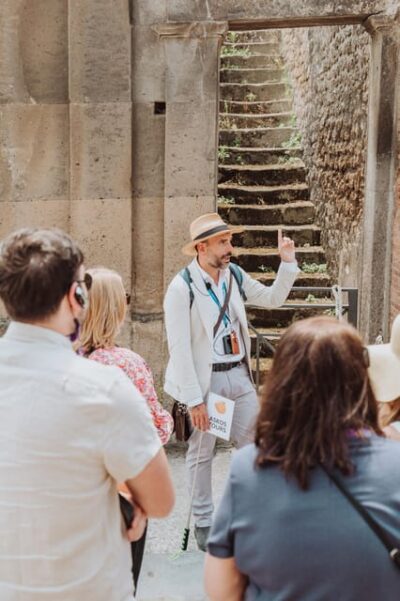
The guide’s role matters here. Without one, you can spend a lot of time navigating the sites and trying to work out what a row of rooms or a worn threshold tells you. An archaeologist can connect the stones and wall decoration to the people who used them. Guides named in accounts of the experience include Michele, Diego, Paulo, Antonio, Michael, and Alfredo. The assigned guide can vary, but the most consistent strength is the way guides explain architecture and everyday life while welcoming questions.
This is a focused visit rather than an exhaustive one. You’ll cover important landmarks in both places, but the pace can feel brisk, particularly in Pompeii. If your aim is to see the main sites, learn their context, and avoid managing the transfer yourself, that is a fair trade. If you want to linger over frescoes, revisit a house, or take side streets at your own pace, plan a return visit.
Pompeii begins at the Forum and Basilica
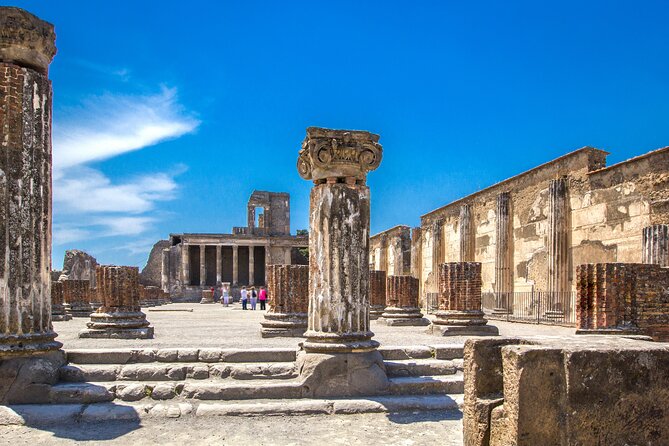
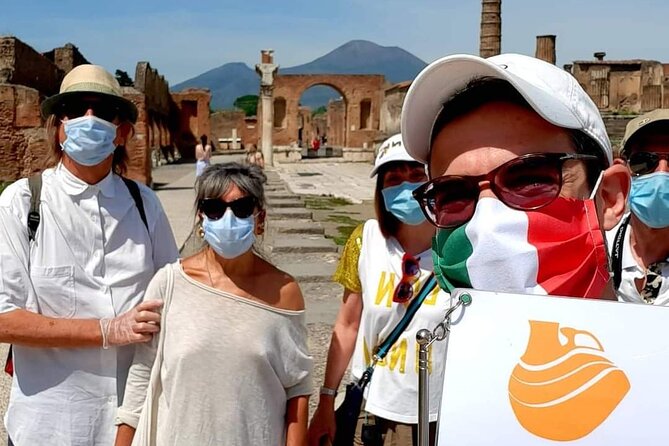
Meet your guide at Porta Marina Superiore if you choose the Pompeii departure. The tour begins among the city’s public spaces, including the Basilica, an open portico used by merchants and for other activities, and the Forum, Pompeii’s main square. These stops help set the scene: this was not simply a collection of grand homes, but a working city with civic and commercial life.
The listed route also follows Pompeii’s main street. That street-level view is one of the most useful parts of the visit. A guide can point out how the city was laid out and help you make sense of the movement between public buildings, shops, and homes. With just a short stop at each landmark, though, expect an overview rather than an extended explanation at every corner.
At the House of Menander, you’ll see one of Pompeii’s grand residences, noted for its architecture, decoration, and contents. The House of the Faun is another major home, and one of the largest private residences in the city. These houses offer a glimpse of wealth and status, while their scale also makes clear how different the lives of elite families were from those of ordinary residents.
The route includes the Stabian Baths, the oldest thermal complex in Pompeii, and the Lupanar, the city’s best-known brothel. Together, they reveal different sides of public and private life. The baths were a major civic space, while the Lupanar is a small but memorable stop that brings the city’s less polished history into view.
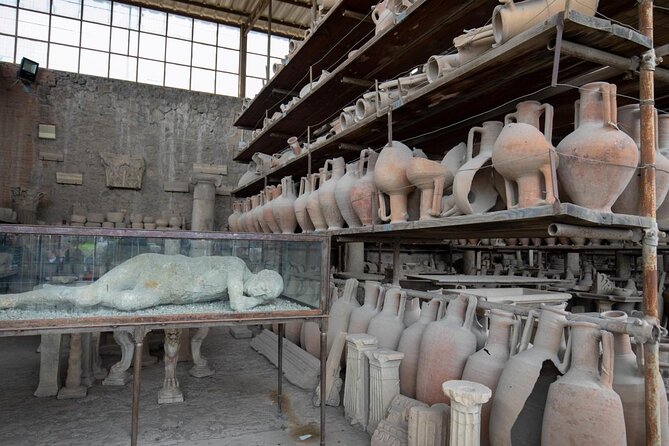
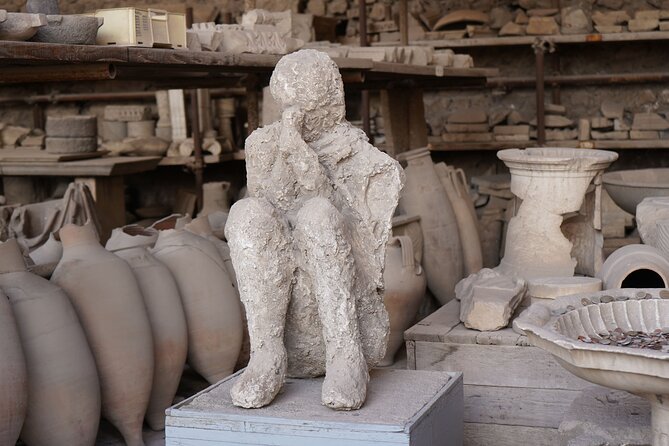
You’ll also visit the Granaries of the Forum, where marble tables and fountain baths are displayed, along with casts of victims, a dog, and a tree. These casts can be affecting. They turn the eruption from an abstract historical event into a human tragedy, though the short visit may not leave much time to absorb what you’re seeing.
The Pompeii itinerary also includes the small Odeon and the Teatro Grande. Both help show how performance and public gatherings fitted into city life. The stops give you a broad sweep of the site, but Pompeii’s size is the catch: two hours is enough for key landmarks with a guide, not for every building or the full range of its collections. One guide-led visit may not include the Antiquarium, for example.
More Sorrento tours in Pompeii:
- Pompeii: Entry Ticket and Guided Tour with an Archaeologist
★ 4.8 · 19,459 reviews - Pompeii: Entry Ticket with Optional Audio Guide
★ 4.2 · 12,360 reviews - Pompeii: Small Group Tour with an Archaeologist
★ 4.8 · 12,264 reviews
Lunch is a short pause, not a meal plan
There is a brief lunch break between the two archaeological sites, and food is not included. The day’s schedule matters here. You are moving between sites and are unlikely to have time for an unhurried restaurant meal, so it’s sensible to bring a snack or pack a simple lunch.
Some versions of the tour stop at a mall for lunch, with several food choices. That can be practical and avoids the tourist-oriented eateries close to the entrance, but it may feel like an abrupt change of scene after Pompeii. If you’d rather not rely on the stop, bring food with you. A snack before boarding the Circumvesuviana train is particularly useful on the Pompeii departure, where the journey and walk to Herculaneum follow the break.
The transfer depends on where you start
The tour has several departure options, and the transport is not identical for all of them. From Naples, meet outside Starhotels Terminus; from Sorrento, meet at Piazza Angelina Lauro. These options include round-trip transport and a minibus transfer between the sites. The Rome option includes train tickets between Rome and Naples, plus full-day transport, with drop-off at Naples station at the end.
If you start in Pompeii, meet at Porta Marina Superiore. The transfer to Herculaneum is by Circumvesuviana train with your guide, using the included one-way ticket. The train ride takes about 30 minutes, followed by a walk of roughly 10 minutes from Ercolano Scavi station to the entrance. That arrangement is useful, but there is an important detail: the Pompeii option concludes at Herculaneum, and the return trip to Pompeii is not included. You’ll need to arrange your own way back if you leave a car or belongings there.
For the Naples, Sorrento, and Rome departures, the minibus takes you directly toward Herculaneum. That removes the need to work out the train transfer yourself and can make the day easier, especially if you are staying farther away. The total duration ranges from about 6 to 11 hours, depending on the option and transport arrangements, so check the departure details that apply to your chosen starting point.
Herculaneum rewards a closer look
Herculaneum is the second major visit, with about two hours led by the archaeologist. It is smaller than Pompeii, but its houses and public buildings give the visit a different texture. The route includes the House of the Deer, named for marble statues of deer found in its peristyle, and the terrace of Marcus Nonius Balbus, a prominent benefactor who restored and built public buildings.
The College of the Augustales is thought to have served the cult of Emperor Augustus, or perhaps as a local civic building. The House of the Relief of Telephus is notable for its scale and its private access to the nearby Suburban Baths. These are good examples of why a guide adds value: the name of a building is only a starting point, and its layout or public role can be easy to miss if you’re moving through alone.
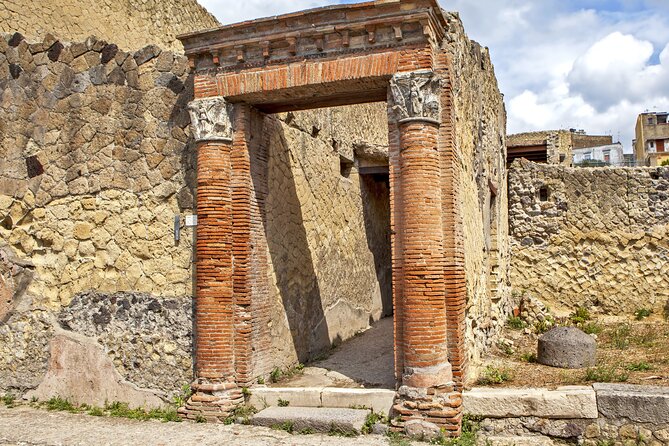
Other stops include the House of the Wooden Partition, known for its surviving wooden divider, and the House of the Skeleton, named after human remains found in an upper room. You’ll also see the Central Baths, which had separate entrances for men and women, and the House of the Black Hall, a luxurious home whose entrance retains carbonized wooden doorposts and lintel.
The Samnite House has an atrium surrounded by a gallery with Ionic columns, while the House of the Beautiful Courtyard has a courtyard, stairway, and stone balcony in place of a traditional atrium. The House of the Grand Portal adds more architectural detail, including columns, frescoes, and charred wooden remains. These homes are among the visit’s most compelling stops because they show domestic spaces at close range.
The itinerary lists many Herculaneum landmarks, but it also gives only about two hours for the site. The guide will lead you through selected highlights, not every room or building. Even so, the shorter route can feel like a better fit here than at Pompeii, where the sheer scale makes a guided overview feel more compressed.
Same coastline, a different kind of day:
- Pompeii Small Group Tour with an Archaeologist
★ 5.0 · 6,593 reviews - Pompeii: Skip-the-Line Entrance Ticket with Audio Guide
★ 4.0 · 2,509 reviews - Naples: Pompeii and Mt. Vesuvius with Lunch and Wine Tasting
★ 4.5 · 2,454 reviews - Pompeii: Archaeological Park Tour with Ticket on request
★ 4.5 · 2,283 reviews
What $77.09 buys you

At $77.09 per person, the price includes admission to both archaeological sites, a guided visit at each, and headsets. The stated adult entry prices are €20 for Pompeii and €16 for Herculaneum, so included tickets account for a substantial part of the cost before you consider the guide and transport. The tour also saves you from planning the connection between the sites, though exactly how much transport is included depends on your departure option.
For a history-focused day, that is solid value. You are paying for context and coordination as much as for access. The guide can help you understand what you’re looking at, and the headsets make it easier to follow along without crowding around every explanation. The group is capped at 20 people, which is more manageable than a large coach group, though it is not a private tour.
The value is weaker if you mainly want free time or already know the sites well. You’ll be moving at the group’s pace, and the tour covers only a selection of Pompeii and Herculaneum. If your ideal day means following your own route, stopping for photographs, or spending longer in a particular house, separate visits may suit you better.
Who will get the most from this tour
I’d choose this tour if you want to see both sites in one day and care about the historical explanation. It is especially useful if you are based in Naples or Sorrento and would rather have transport arranged, or if you are in Rome and want a guided day with the train connection and site transfers handled as part of the option.
It also suits first-time visitors who want a clear introduction before deciding whether to return. The guide-led route can help you notice details you might otherwise walk past, from a wooden partition to the design of a bath complex. The most praised feature is the guide’s ability to make daily Roman life understandable, with an engaging, conversational style and room for questions.
I would hesitate if you dislike a brisk pace, need long rest breaks, or want to explore Pompeii thoroughly. The sites involve walking, and the tour is not recommended for people with visual impairments unless they have a dedicated personal assistant. Confirmation is provided at booking, and free cancellation is available up to 24 hours before the start time.
Should you book it?
Book this if you want a guided introduction to Pompeii and Herculaneum, with entry tickets and the connection between the sites taken care of. The archaeologist’s explanations are the main reason to choose it, and seeing both towns makes the day more rewarding than visiting either in isolation.
Skip it if slow exploration is your priority. Two hours at Pompeii is a taste, not a full visit, and the Pompeii departure ends at Herculaneum rather than returning you to Pompeii. Choose your start point carefully, bring a snack, and treat the day as a strong overview of two remarkable sites, not the last word on either one.
FAQ
How long does the tour take?
The full experience lasts about 6 to 11 hours. The exact duration depends on your selected departure option and transport arrangements.
Where are the meeting points?
For the Pompeii option, meet at Porta Marina Superiore. The Naples meeting point is outside Starhotels Terminus, and the Sorrento meeting point is Piazza Angelina Lauro. The Rome option also meets at Starhotels Terminus.
Are admission tickets included?
Yes. Entry to Pompeii and Herculaneum is included, along with guided visits and headsets.
How do you travel between Pompeii and Herculaneum?
From Naples, Sorrento, and Rome, the transfer is by modern minibus. From Pompeii, you travel with the guide by Circumvesuviana train, then walk about 10 minutes from Ercolano Scavi station.
Does the Pompeii departure include a return to Pompeii?
No. The Pompeii option ends at the Herculaneum ruins. The return journey to Pompeii is not included, so you’ll need to arrange it yourself.
Are meals included?
No. Meals and drinks are not included. There is a short lunch break between the sites, and you can bring your own food.
How many people can join the tour?
The maximum group size is 20 people.
Is the tour offered in English?
Yes. The tour is offered in English.
New this season around Pompeii
- Scooter rental on the Amalfi Coast★ 5.0 · 90 reviews
- Pompeii: Archeological Tour & Wine Tasting at Mt. Vesuvius★ 4.6 · 142 reviews
- Pompeii: Skip-the-Line Guided Tour★ 4.6 · 139 reviews
- Ancient Pompei in the afternoon★ 5.0 · 140 reviews
- Pompeii: 2-Hour Guided Tour with an Archaeologist★ 4.9 · 151 reviews
- Pompei: Pompeii Private Tour★ 4.8 · 146 reviews
- Horseback Riding on Vesuvius★ 5.0 · 144 reviews
- Pompeii Skip-the-Line Entry Small Group Guided Tour★ 5.0 · 151 reviews
Pompeii Tours, compared.
Pompeii: Entry Ticket and Guided Tour with an Archaeologist
Read our review →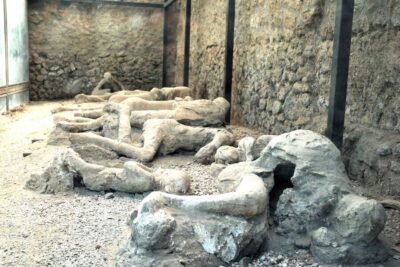
Pompeii: Entry Ticket with Optional Audio Guide
Read our review →
Pompeii: Small Group Tour with an Archaeologist
Read our review →
Pompeii: Skip-the-Line Entrance Ticket with Audio Guide
Read our review →
Naples: Pompeii and Mt. Vesuvius with Lunch and Wine Tasting
Read our review →
Pompeii: Archaeological Park Tour with Ticket on request
Read our review →
Discover the Ancient Ruins of Pompeii: Day Trip from Rome
Read our review →
Browse the lists this tour appears in