
Reviewed · POMPEII TOURS
Explore Pompeii with an Archaeologist
Pompeii is a whole Roman city, not a handful of ruins, and two hours with an archaeologist can help you make sense of its streets, public buildings, baths, homes, and theater. This tour moves through many of the best-known sights, from the Forum to the House of the Vettii, with admission included and the main entrance line avoided.
I like two things in particular: the small-group limit of 20 leaves room for questions, and a guide can connect each building to everyday life instead of leaving you to decipher walls on your own. The route also gives you a useful overview before you decide where to spend more time afterward.
The trade-off is pace. Twelve stops in roughly two hours means concise explanations, and crowds can still slow you down inside the site or make it hard to hear. Pompeii also means plenty of walking over uneven ground, so bring water, sun protection, and shoes you can trust.
At a glance
- A fast route through major sights: Visit the Forum, Basilica, Lupanar, House of Menander, House of the Faun, baths, and theater.
- An archaeologist leads the walk: The guide explains the buildings and answers questions, rather than leaving you with labels to interpret alone.
- Admission is included: You meet at Porta Marina Superiore, with skip-the-line entry intended to reduce the wait at the entrance.
- The group can reach 20: Headsets are supplied when the group has 16 or more people.
- Plan to keep exploring: The tour is a strong introduction, not a complete visit to a city that takes much longer to see.
A two-hour introduction to a city underfoot
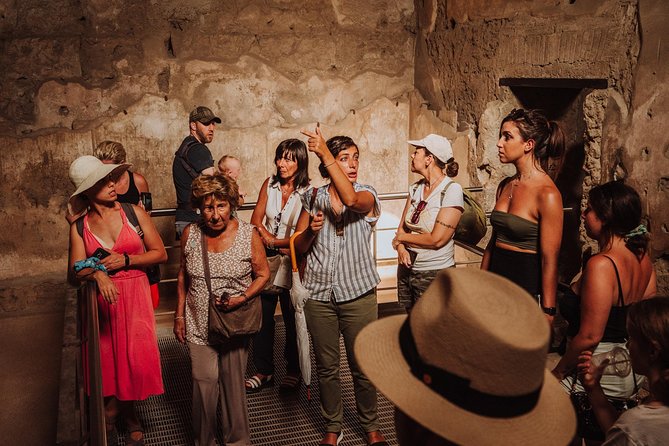
Pompeii’s scale is the first thing to grasp. This was a functioning city, with civic spaces, homes, shops, baths, and a theater. Its streets are not a museum corridor designed to be crossed in a few minutes. A guided route helps you notice how the different parts fit together and gives names and purpose to the remains.
The tour lasts about two hours and covers a dozen stops, including the meeting point. That makes it a brisk introduction, not a slow, room-by-room examination. Your guide sets the pace and selects the main sights; you can continue exploring independently when the guided portion ends.
The advertised guide is an archaeologist, and that matters most when you want context rather than a photo stop. The guide can explain what a building was used for and help you connect one part of the city to the next. The tour has been led by guides including Mario, Julia, Alexandra, Ilaria, Diego, Antonio, Rosanna, Rafaela, Teresa, Jolanta, and Sergio, but you should not expect a particular person unless your booking confirms it.
More Sorrento tours in Pompeii:
- Pompeii: Entry Ticket and Guided Tour with an Archaeologist
★ 4.8 · 19,459 reviews - Pompeii: Entry Ticket with Optional Audio Guide
★ 4.2 · 12,360 reviews - Pompeii: Small Group Tour with an Archaeologist
★ 4.8 · 12,264 reviews
Meeting at Porta Marina Superiore
The tour begins at the Archaeological Park of Pompeii, at Porta Marina Superiore. The meeting address is Via Villa dei Misteri, 2, Pompei. Look for the guide holding a sign with the company name Askos Tours.
Arrive with enough time to find the entrance and your group. The tour includes skip-the-line admission, but that does not mean the whole archaeological site will be free of queues. Some rooms can draw lines inside the park, and busy periods may bring crowds along the route.
The guide takes care of the site entry and leads the group from there. Transportation to Pompeii is not included, so you need to arrange your own way to the meeting point. The site is near public transportation, and one useful option noted by tour participants is arriving by train.
The Forum and Basilica: Pompeii’s public center
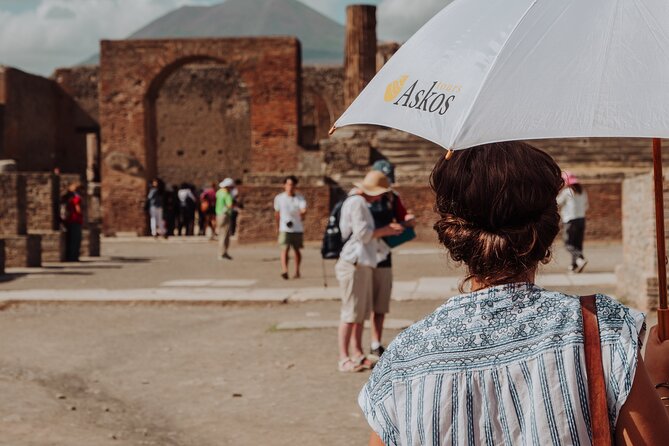
The first major stop is the Forum, Pompeii’s main square. It is a good place to begin because it gives you a sense of the city’s public heart before the tour turns toward homes, businesses, and leisure spaces. Your guide can help you read the scale and layout instead of seeing only a broad open area ringed by ruins.
Nearby, the Basilica served as a courthouse. The change from open square to civic building shows that Pompeii was more than a collection of private houses. These two stops are allotted about 10 minutes apiece, so expect a focused explanation rather than time to wander through every corner.
Lupanar and the Forum granaries
The Lupanar, identified as Pompeii’s brothel, is one of the stops likely to prompt questions. It offers a direct look at a part of urban life that can feel more immediate than a grand civic building. The guide’s interpretation is useful here, especially if you want to understand the place in context rather than treat it as a quick curiosity.
The Forum granaries provide a different view of daily needs. Their function as ancient granaries shifts the focus from public business and private life to the storage of food. The tour allows about 10 minutes at each stop. If the site is crowded, you may have to wait to enter particular spaces, which can compress the time available for explanation.
Same coastline, a different kind of day:
- Pompeii Small Group Tour with an Archaeologist
★ 5.0 · 6,593 reviews - Pompeii: Skip-the-Line Entrance Ticket with Audio Guide
★ 4.0 · 2,509 reviews - Naples: Pompeii and Mt. Vesuvius with Lunch and Wine Tasting
★ 4.5 · 2,454 reviews - Pompeii: Archaeological Park Tour with Ticket on request
★ 4.5 · 2,283 reviews
Two grand homes: Menander and the House of the Faun
The House of Menander and the House of the Faun offer a look at domestic Pompeii on a larger scale. The names alone suggest how particular homes have become landmarks within the archaeological park, and the guided visit gives you a chance to compare residential spaces with the public buildings seen earlier.
The House of the Faun is one of the route’s headline sights. As with other homes, the value of a guide is in explaining what you are looking at and how it fits into the city’s layout. Each house has about 10 minutes in the schedule, so you should not expect a leisurely visit to every room or a deep architectural study.
Crowd levels matter here. Lines can form for popular rooms, and visitors gathered in a confined space can make it harder to hear. If you are particularly interested in Pompeian homes, plan to stay after the tour and explore at your own pace.
Stabian Baths and Via dell’Abbondanza
The Stabian Baths add another piece to the picture of city life. The tour identifies them as ancient baths, a useful contrast with the homes and civic buildings. Your guide can explain the site’s role as part of the route’s broader overview, but the short stop means you will need to choose what to examine most closely.
Via dell’Abbondanza is the named street on the itinerary. Walking along a street helps make Pompeii feel like a city rather than a set of isolated attractions. It is also a reminder that the spaces between famous buildings are part of the visit. The route gives you about 10 minutes here, with no separate admission ticket required for this stop.
Expect uneven surfaces and a good deal of walking throughout the tour. One participant described it as a workout, which is fair warning: Pompeii is not a smooth, compact stroll. Comfortable shoes are more useful than dress shoes, and a refillable water bottle is a smart choice. Drinking water is available from fountains in the park.
Thermopolium, Teatro Grande, and Casa dei Vettii
The Thermopolium, described as an ancient food counter, brings the tour back to everyday commerce. It is a compact stop, but it helps round out the picture of a working city alongside the homes, baths, and civic buildings.
Teatro Grande is the route’s theater stop. A theater gives you a different sense of communal life from the Forum or Basilica, and it offers a change of scale after the street and house visits. The final named sight is Casa dei Vettii, or the House of the Vettii. It is another chance to see a Pompeian home before the tour ends.
Each of these stops is allotted about 10 minutes. The schedule offers breadth, which is helpful if you have limited time, but it cannot cover every corner of the park. You may also find that an individual stop takes longer or shorter depending on how busy the site is that day.
What the small group and guide add
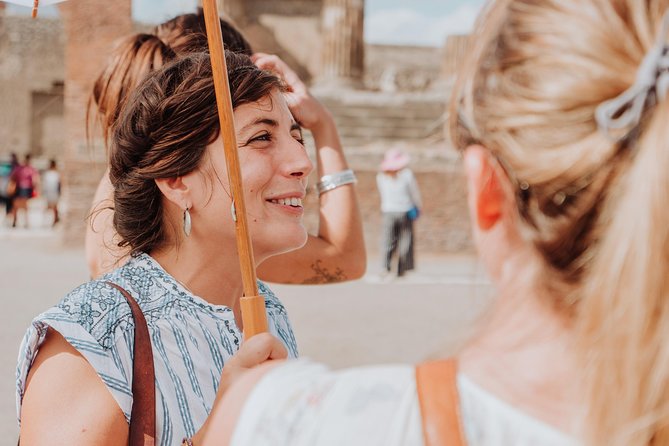
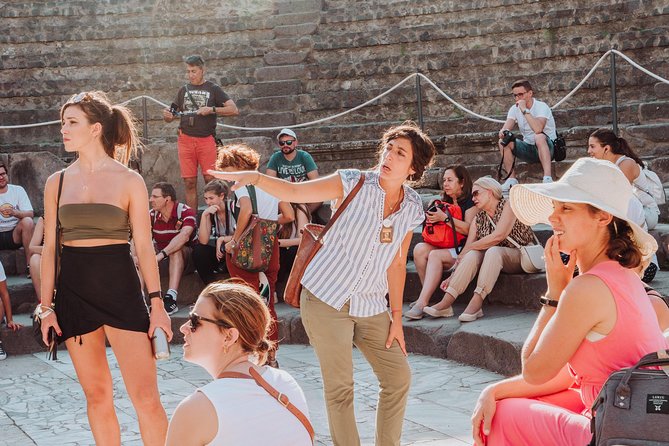
A maximum of 20 people per guide is a useful middle ground. It is not a private tour, but it is small enough for questions to be practical, especially when the group is not at full capacity. If there are 16 or more people, headsets are included, which can help you hear the guide in a large, noisy archaeological site.
The strongest feature is the human explanation. Several guides are singled out for clear explanations, patience with questions, a good pace, and the ability to make the route engaging for families. Mario, Teresa, Alexandra, and Rosanna are among the named guides who have led tours. One guide was praised for checking whether the pace felt too fast or too slow, a small courtesy that can make a long walk more comfortable.
Quality can still depend on the person leading your group. One participant found a guide slow and short on interaction, while another felt crowds and earphone noise got in the way. That is a reasonable caution: you are paying for interpretation, but a group tour cannot guarantee a perfect fit in pace, delivery, or access to every room.
Is $35.67 good value?
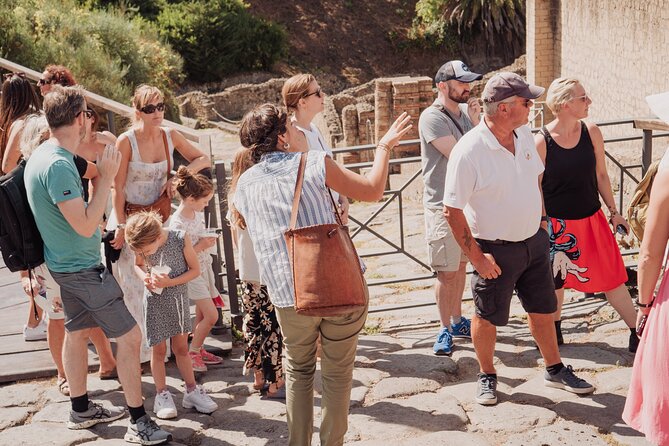
At $35.67 per person, the price includes Pompeii admission, an archaeologist as guide, and headsets for groups of 16 or more. You are paying for a guided overview and a more direct way into the site, not transportation, food, or a full-day visit. If you would otherwise buy entry and try to make sense of the route alone, the added context can be worth the cost.
The main value is time and orientation. Pompeii is large enough that a first-time visitor can easily spend hours walking without forming a clear picture of how the city worked. A two-hour guided route helps you identify key places, then continue exploring independently with a better sense of direction.
The compromise is depth. If you want to spend a long time in the houses, focus on current excavation areas, or ask detailed questions at every stop, a private guide or longer visit may suit you better. This tour is designed to cover a lot of ground in a short window, not to satisfy every specialist interest.
Practical details before you book
The tour is offered in English, and confirmation is received at booking. It is typically booked about 30 days in advance, so reserve early if you have fixed dates. Free cancellation is available up to 24 hours before the start time; changes or cancellations inside that window are not accepted for a refund.
If you are visiting in summer, prepare for heat. Bring a hat or umbrella and water, and take the walking seriously. For minors under 18, bring a passport or ID to qualify for free admission.
Dogs are permitted only if they weigh no more than 10 kg and are no taller than 40 cm. They must remain on a leash and be carried in your arms inside buildings, and you are responsible for collecting their waste. Service animals are also allowed.
The tour ends at Piazza Esedra. You can stay in the archaeological park afterward and continue exploring on your own, which is a good idea if you have the time. Two hours is enough for a guided orientation, but not enough to see everything Pompeii offers.
Who should book this Pompeii tour?
Book it if you want an efficient first visit, prefer a guide to explain what you are seeing, and are comfortable walking at a steady pace. It is particularly useful for families and for anyone who wants a clear route through the major sights without planning every stop in advance.
Think twice if you want a slow, highly detailed visit or need a quiet setting. Crowds, queues inside the park, and the pace of a group can limit time at individual buildings. If those trade-offs suit you, this is a practical way to get your bearings, ask questions, and leave with a plan for what to explore next.
FAQ
How long is the tour?
It lasts about two hours.
What is the price?
The listed price is $35.67 per person.
Is Pompeii admission included?
Yes. Pompeii admission is included in the tour price.
Where does the tour start?
Meet at Porta Marina Superiore, at Via Villa dei Misteri, 2, Pompei. Look for the guide holding an Askos Tours sign.
Where does the tour end?
The tour ends at Piazza Esedra.
What language is the tour offered in?
The tour is offered in English.
How large can the group be?
The maximum group size is 20 people per guide.
Are headsets provided?
Yes, headsets are provided for groups of 16 or more.
Is transportation included?
No. Transportation, food, and drinks are not included.
What identification should visitors under 18 bring?
Visitors under 18 are advised to bring a passport or ID to qualify for free admission.
New this season around Pompeii
- Scooter rental on the Amalfi Coast★ 5.0 · 90 reviews
- Pompeii: Archeological Tour & Wine Tasting at Mt. Vesuvius★ 4.6 · 142 reviews
- Pompeii: Skip-the-Line Guided Tour★ 4.6 · 139 reviews
- Ancient Pompei in the afternoon★ 5.0 · 140 reviews
- Pompeii: 2-Hour Guided Tour with an Archaeologist★ 4.9 · 151 reviews
- Pompei: Pompeii Private Tour★ 4.8 · 146 reviews
- Horseback Riding on Vesuvius★ 5.0 · 144 reviews
- Pompeii Skip-the-Line Entry Small Group Guided Tour★ 5.0 · 151 reviews
Pompeii Tours, compared.
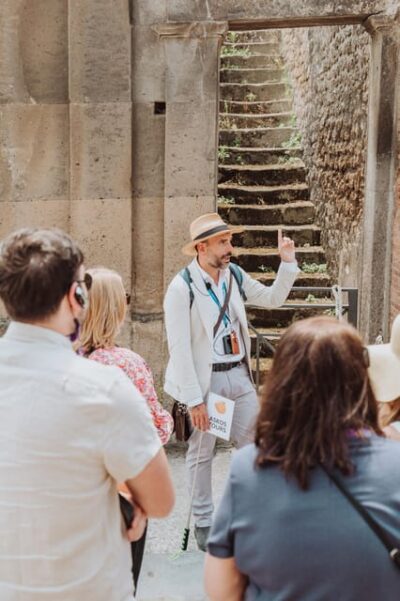
Pompeii: Entry Ticket and Guided Tour with an Archaeologist
Read our review →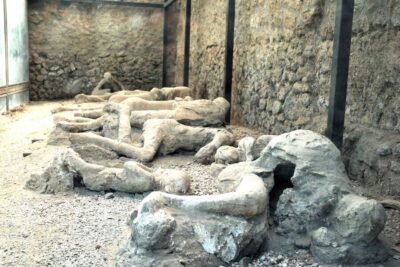
Pompeii: Entry Ticket with Optional Audio Guide
Read our review →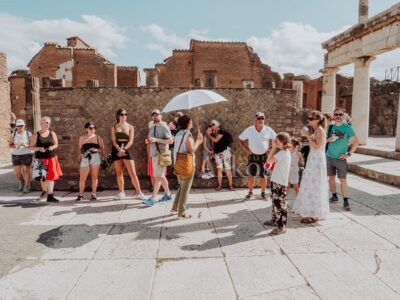
Pompeii: Small Group Tour with an Archaeologist
Read our review →
Pompeii: Skip-the-Line Entrance Ticket with Audio Guide
Read our review →
Naples: Pompeii and Mt. Vesuvius with Lunch and Wine Tasting
Read our review →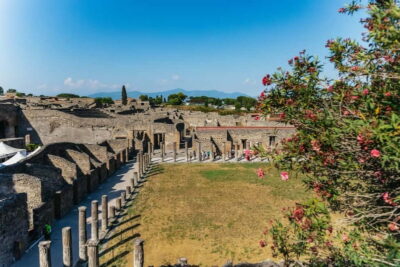
Pompeii: Archaeological Park Tour with Ticket on request
Read our review →
Discover the Ancient Ruins of Pompeii: Day Trip from Rome
Read our review →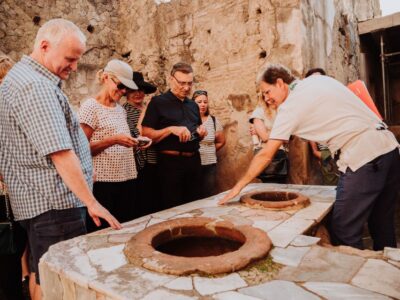
Browse the lists this tour appears in