Reviewed · PAESTUM TOURS
Paestum Tour: Best Preserved Temples in the World (UNESCO)
Paestum’s three remarkably preserved Greek temples are the heart of this tour: their massive Doric columns make the ancient city’s scale easy to grasp, even before you know the stories behind them. A licensed guide leads you through the archaeological park and its museum in a focused two-hour visit.
I like that the route pairs the temples with the Roman forum and amphitheater, then finishes with the museum’s famous Tomb of the Diver. I also like that it’s a private tour, with a guide who can answer your questions. The main consideration is cost: the $325.13 group price does not include entrance tickets or transportation, and may be less attractive if you’re travelling alone or as a small group.
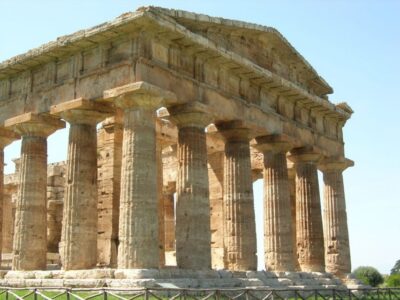
- Three striking Doric temples: See the buildings dedicated to Hera, Poseidon and Athena, also called Ceres in the tour description.
- A guide who can explain the architecture: Expect a licensed guide, with clear explanations of the temples and their history.
- Roman remains on the route: Walk along the Via Sacra to the Roman forum and amphitheater.
- A museum finale: See the Tomb of the Diver, plus metopes, a statue of Zeus and a European-themed crater.
- Private group format: The listed price covers a group of up to 25, with English, Spanish, French, German and Italian available.
- Plan for separate costs: Park and museum tickets, food and transport are not included.
Start at the museum, then meet ancient Paestum
The meeting point is the entrance to the National Archaeological Museum in Paestum. From there, your guide takes you through the archaeological park before returning to the museum to finish the visit. It’s a compact route that connects the stones outdoors with objects and painted scenes indoors.
Paestum began as Poseidonia, a Greek city in Magna Graecia, and later took the Roman name Paestum. The city was named for Poseidon, though its religious life also honored Athena and Hera. That blend of Greek foundations and Roman civic remains gives the tour its shape: temples first, then the forum and amphitheater, followed by the museum.
The two-hour duration makes this a concentrated introduction rather than an unhurried day among the ruins. A guide can help you notice the differences between the buildings and put the surviving structures in context. You’ll have less time to linger independently, so if you like to study every inscription or spend a long stretch in museums, consider whether this pace suits you.
Hera’s Basilica shows the scale of the Greek city
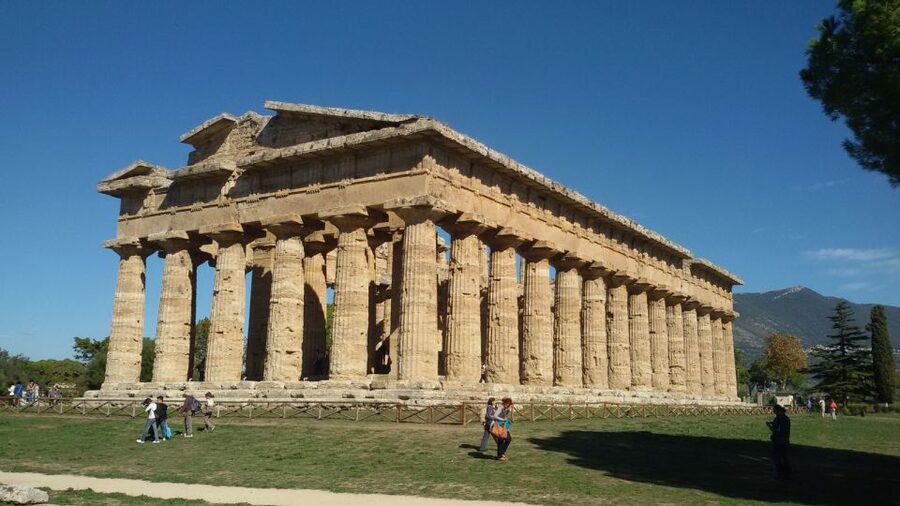
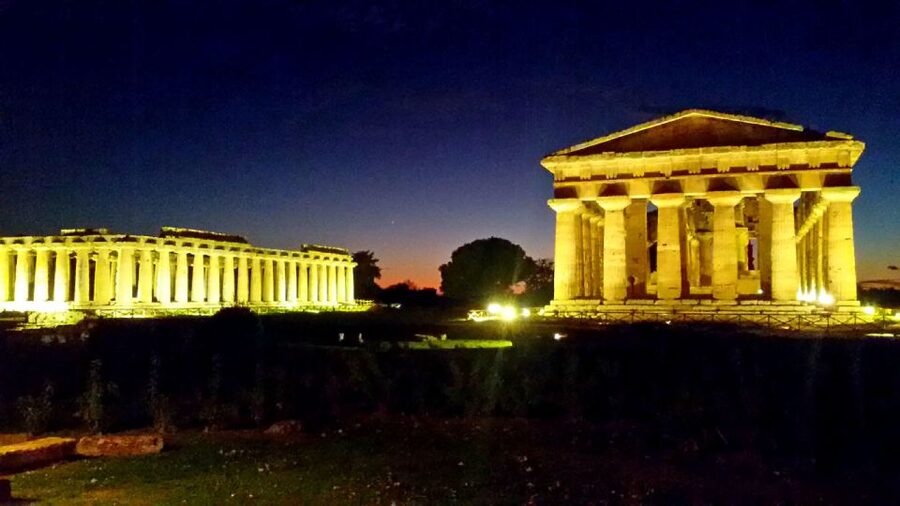
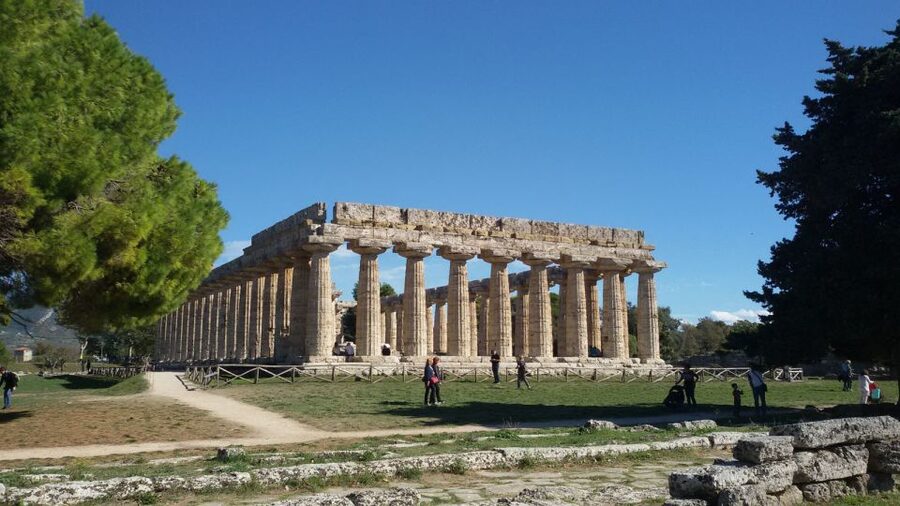
The first temple is dedicated to Hera and is also called the Basilica. It is the oldest of the three, built in the Doric style, and measures about 26 metres across and 55 metres long. Those figures help explain why the building matters: this is not a small sanctuary tucked into a corner, but a structure whose size still commands attention.
The name Basilica can be confusing if you associate it only with later Christian churches. Here, it is the traditional name given to the temple. Your guide can help make sense of the terminology and the temple’s form, rather than leaving you to guess what you’re looking at.
This is where a guided visit can make the stones more legible. The strongest praise for the tour centers on explanations of architecture and history, as well as a guide’s willingness to answer questions. That’s particularly useful at Paestum, where the temples are visually powerful but can blur together if you don’t know what to look for.
More Paestum trips in Sorrento:
- Paestum: Small-Group Tour with an Archaeologist and Tickets
★ 4.9 · 451 reviews - Paestum: Temples and Museum Tour with Archaeologist Guide
★ 5.0 · 14 reviews - Paestum: 2-Hour Greek Temples & Archaeological Museum
★ 4.8 · 19 reviews
Poseidon’s temple is the monumental centerpiece
The largest temple is dedicated to Poseidon, also known as Neptune. It was built around 460 BCE in the Doric style, and is described as comparable to the Temple of Zeus at Olympia. Even without a detailed lecture, the scale and repeated columns make it an arresting stop.
A guide can help you compare this building with Hera’s Basilica and see how the temples differ in size and character. That comparison gives the walk a useful rhythm: first the oldest temple, then the largest, then the sanctuary of Athena. Rather than treating the park as one long row of ruins, you get three clear landmarks to remember.
The tour calls the third temple the Temple of Ceres, while also identifying it as a sanctuary dedicated to Athena. Keep both names in mind as you go. The building is more modest in size than Poseidon’s temple, but the scale is not the only measure of interest. Its religious dedication and place in the sequence add another layer to the story of Paestum.
The Via Sacra leads to Rome’s public spaces
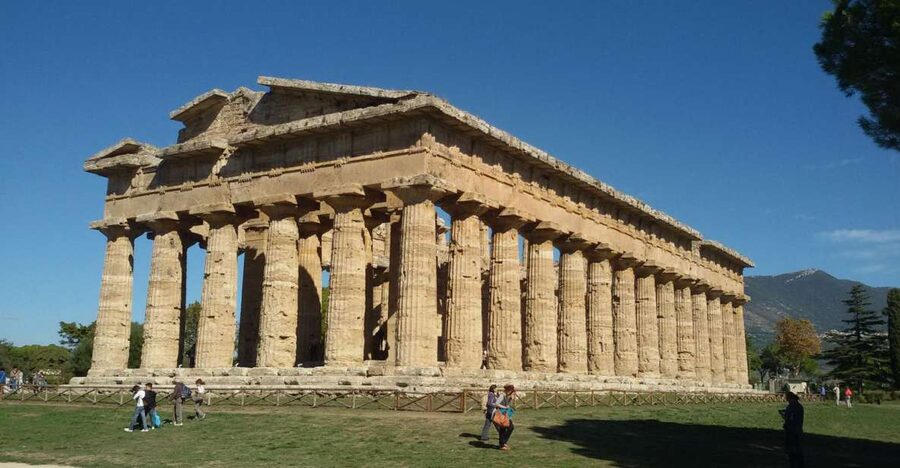
After the temples, the route follows the Via Sacra toward the Roman forum and amphitheater. These remains shift the focus from Greek religious architecture to civic life under Roman rule. The change helps you see Paestum not as a single moment frozen in time, but as a city with successive identities.
The forum is a useful counterpoint to the sanctuaries. Temples speak of worship and devotion; a forum points to the public and political center of Roman life. The amphitheater adds another kind of civic gathering place. The tour’s short schedule means these stops are part of a broad overview, not an extended examination of every feature.
If your main reason for visiting Paestum is the Greek temples, these Roman remains provide welcome context without taking over the visit. If Roman sites are your chief interest, check whether two hours is enough for the level of detail you want. The guide’s explanations and the private format can make the time more productive, but they cannot turn a short tour into a full-day exploration.
The Tomb of the Diver gives the museum its emotional force
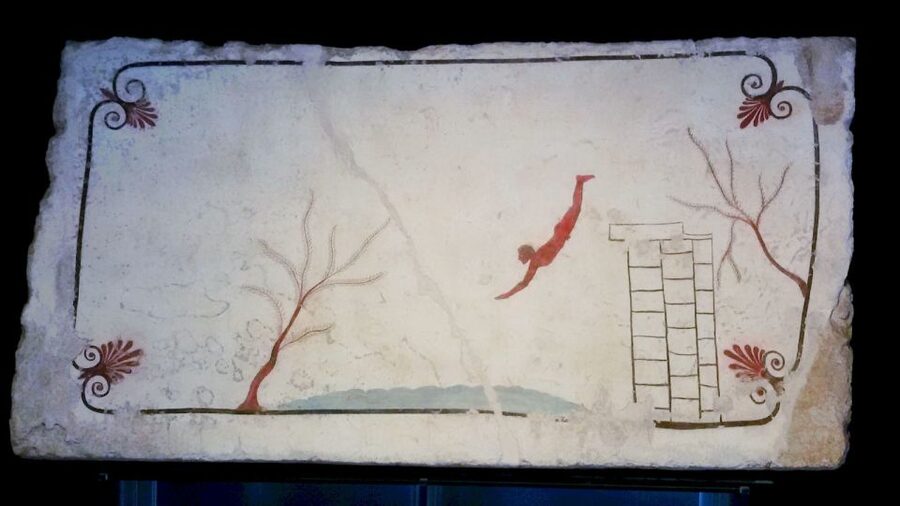
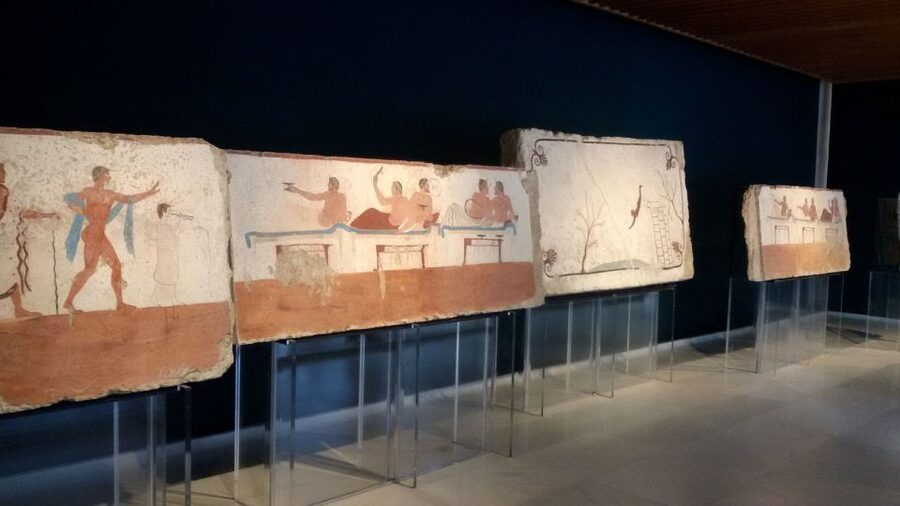
The visit ends at the National Archaeological Museum, where the best-known object is the Tomb of the Diver. It is made from five limestone slabs of local travertine, plastered and decorated with figurative wall paintings using the fresco technique. The painted image of a diver gives the tomb its name.
This is a striking change of scale after the great temples. Outside, you’ve been looking at enormous buildings; in the museum, the attention shifts to a painted burial chamber and its carefully described construction. The Tomb of the Diver is not just a famous image to tick off. Its materials and painted decoration offer a more intimate view of ancient funerary art.
The museum visit also includes 33 metopes from the Temple of Hera Argiva, a statue of Zeus and a crater featuring the story of Europa and the bull. These objects make the museum more than a final stop to escape the ruins. They add details that a walk among the temples alone cannot provide, linking the park’s architecture with sculpture, decoration and painted scenes.
The museum is included in the guided route, but admission is not included in the tour price. That distinction matters when comparing costs: the guide’s service covers both the archaeological park and museum, while you still need to pay the entry fees separately.
More Sorrento tours in Sorrento:
- Pompeii: Entry Ticket and Guided Tour with an Archaeologist
★ 4.8 · 19,459 reviews - Pompeii: Entry Ticket with Optional Audio Guide
★ 4.2 · 12,360 reviews - Pompeii: Small Group Tour with an Archaeologist
★ 4.8 · 12,264 reviews - Pompeii Small Group Tour with an Archaeologist
★ 5.0 · 6,593 reviews
What the private format means for your visit
The tour is private, and the listed $325.13 price covers a group of up to 25 people. For a larger family or group, sharing one guide can make the price reasonable per person. For one or two people, the flat group cost may feel steep, especially once you add park and museum tickets.
A private guide also means the visit can be shaped around your questions. The tour’s most praised quality is the explanation of architecture and history, with questions answered in a cordial, helpful way. That direct exchange is the main reason to choose a guided visit over simply walking through the site with your own notes.
The guide is licensed, and the available languages are English, Spanish, French, German and Italian. No individual guide’s name is provided, so you cannot request a particular person based on the information available. If a particular language is essential, confirm its availability for your chosen time before booking.
Budget and timing before you book
The tour lasts two hours, with starting times shown when you check availability. Its short length works well if you want a guided overview that covers the essential archaeological park and museum highlights. It is less suited to a visit where you want to move slowly, take extended breaks or spend a long time with individual exhibits.
The $325.13 price is for the group, not an individual ticket. Entrance tickets to the Archaeological Park and National Archaeological Museum are extra. Lunch, dinner and tastings are also excluded, as are transportation and pickup or drop-off. You meet at the museum entrance and finish back at that meeting point, so arrange your own way to Paestum.
The booking terms allow free cancellation up to 24 hours in advance, and the reserve-now, pay-later option means you do not have to pay at the time of booking. Those terms offer flexibility, but they do not change the need to budget for admission and transport.
Who will get the most from this Paestum tour
I’d consider this tour if you want the temples explained rather than simply photographed, and if the Tomb of the Diver is on your must-see list. It suits people who value a structured overview, want to ask questions and prefer to connect the Greek and Roman remains with the museum objects in one visit.
It can also work well for families or groups who want to split the fixed price. With up to 25 people permitted, the per-person cost falls as the group grows, though the tour remains private. For a small party, compare the price with the value you place on having a licensed guide for two hours.
If you already know Paestum well, or want long stretches to explore at your own pace, a guided tour may feel too compressed. You could also find the total cost higher than expected once admission and transportation are added. The central question is whether expert explanation and a clear route are worth the group fee for you.
Should you book it?
Book this tour if you want a focused introduction to Paestum’s three temples, Roman public spaces and museum highlights, especially the Tomb of the Diver. The clearest advantage is the guide’s role in explaining architecture and history and answering questions. The biggest drawback is the extra cost of admission and transport, alongside a fixed group price that is easier to justify with several people.
If those trade-offs work for your plans, it offers a practical way to understand the site in two hours. If you prefer a slower visit or are travelling as a small group on a tight budget, compare alternatives before committing.
FAQ
How long is the Paestum tour?
The guided tour lasts two hours. Starting times are shown when you check availability.
Where does the tour begin?
It begins at the entrance to the National Archaeological Museum in Paestum.
Where does the tour end?
The activity ends back at the meeting point.
Is the tour private?
Yes. It is listed as a private group tour, with a group size of up to 25 people.
Which languages are available?
The live guide is available in English, Spanish, French, German and Italian.
Are entry tickets included?
No. Admission to the Archaeological Park and National Archaeological Museum is not included.
Is transportation included?
No. Transportation, pickup and drop-off are not included.
What are the main stops?
The tour covers the temples of Hera, Poseidon and Athena, also called Ceres in the tour description, along with the Roman forum, amphitheater and National Archaeological Museum.
Can I cancel for a refund?
Yes. You can cancel up to 24 hours in advance for a full refund.
New this season around Sorrento
- Hiking the Path of the Gods with Enzo: Amalfi Coast Adventure★ 5.0 · 104 reviews
- Capri Positano and Amalfi Ischia Private Boat Tour from Sorrento★ 5.0 · 53 reviews
- Path of the Gods Hiking Day Tour from Sorrento★ 5.0 · 110 reviews
- Private transfer from Sorrento to Rome★ 5.0 · 37 reviews
- From Salerno : Amalfi Coast Private Day Trip★ 5.0 · 12 reviews
- Naples/Sorrento/Positano: Private Amalfi Coast Tour by Vespa★ 4.9 · 121 reviews
- Paestum: Temples and Museum Tour with Archaeologist Guide★ 5.0 · 14 reviews
- Ravello: 2-Hour Private Walking Tour★ 4.9 · 12 reviews
Paestum Tours, compared.

Paestum: Small-Group Tour with an Archaeologist and Tickets
Read our review →
Paestum: 2-Hour Greek Temples & Archaeological Museum
Read our review →